


_edited.png)
DMT, Red Lasers, and the 'Code': Science vs Hype Explained

Every few years, psychedelics culture births a new meme-level mystery. The latest: smoke DMT, shine a certain red laser at a wall, and stare into its reflection to witness a hidden “code” beneath reality. Some participants describe crisp, persistent symbols and geometric lattices. Others see nothing beyond a wobbly speckle.
What’s hype, what’s testable, and what remains unknown? DoubleBlind Magazine recently profiled this phenomenon and the people advancing and scrutinizing it, from heavy psychonauts to working neuroscientists (DoubleBlind). Their reporting provides the best single snapshot of claims and counterclaims so far—so let’s follow the evidence they surfaced and keep clear about where the science stops.
For readers across DC, Maryland, and Virginia, this is not a how-to. It’s a reality check on a viral idea, and a reminder that medical decisions—whether about psychedelics or cannabis—should be grounded in evidence, not virality.
What Is the DMT + Red Laser “Code” Experiment?
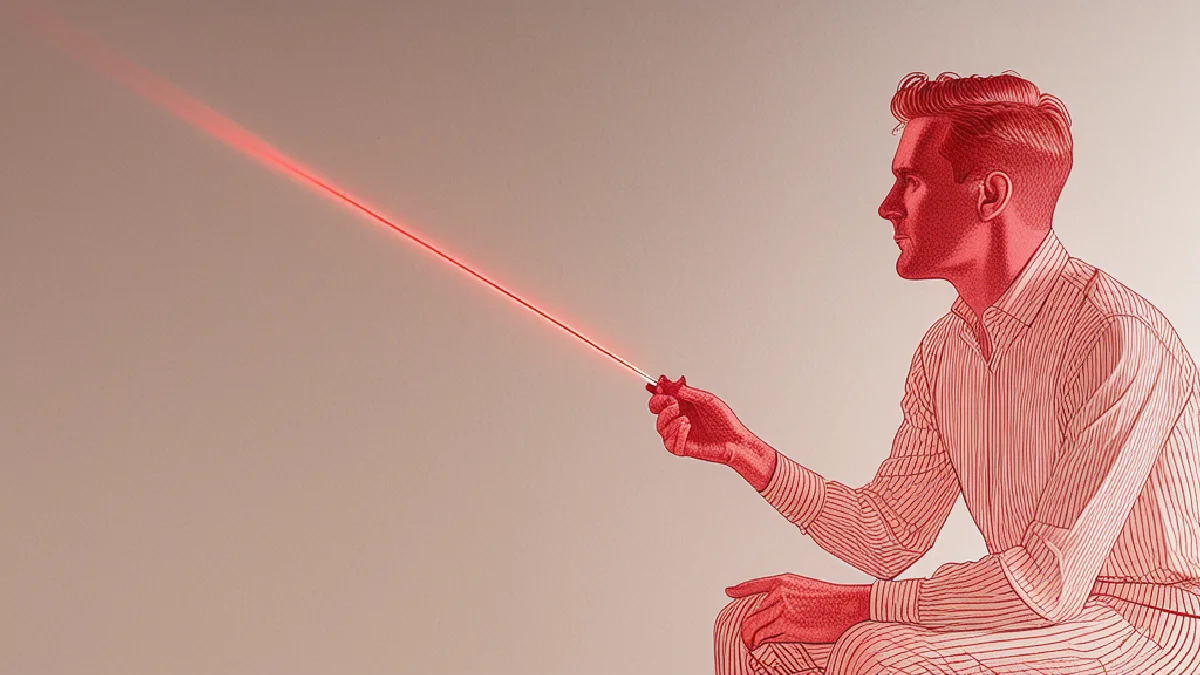
The core claim is simple: during a DMT experience, gazing at the diffuse reflection of a red laser on a wall allegedly reveals an ordered array—sometimes described as characters, sometimes as complex geometric structures—sitting “behind” the surface of ordinary perception. Proponents frame this as a glimpse of the universe’s underlying architecture.
As reported by DoubleBlind, the experiment’s most visible advocate says the visual field can crystallize into an array of repeating polyhedral units that themselves appear composed of symbolic elements. Enthusiasts liken it to seeing a “holodeck” backend or Matrix-like glyphs. The idea has drawn media attention, and a forthcoming documentary trailer has garnered millions of views on TikTok, amplifying the experiment far beyond niche message boards.
Yet many participants, including experienced psychonauts and scientists, report no such code. Others describe intermediate states—patterns hinting at order, but never cohering into a legible alphabet. This variability sits at the center of the debate.
Scientific Evidence and Research Findings
Several researchers and clinicians interviewed by DoubleBlind offered explanations rooted in known perceptual science. One neuroscientist emphasized the role of suggestibility: if participants are primed to expect symbols, their visual system may organize ambiguous input into the predicted outcome. In this view, the “code” is not a portal; it’s a top-down interpretation riding on expectation.
Another researcher with a focus on qualia described the speckle pattern produced by a diffuse laser reflection. When coherent light scatters from an uneven surface, interfering wavefronts create a stable mesh of bright and dark spots. Under psychedelics, the brain’s pattern-completion machinery can compress, map, or rhythmically synchronize with these speckles, making them feel unusually coherent and information-dense—without implying an objective alphabet hidden in the wall.
A psychologist who studies exceptional experiences pointed out the challenge of priming. Because the expected visuals have been widely publicized, it’s nearly impossible to design a clean, blinded test. Once you tell someone to look for “code,” they’ll tend to find order in noise—especially during a state that boosts the brain’s tendency to detect patterns.
On individual variability, a neurobiologist who has written extensively on DMT highlighted a striking knowledge gap: we don’t yet understand why some people experience vivid open-eye visuals on DMT while others see little to none. According to DoubleBlind’s account, reference was made to 1990s work by Strassman in which roughly 5% of participants reported no discernible effects even at very high, so-called “breakthrough” doses. One proposed factor is genetic differences in serotonin receptor structures that modulate sensitivity to DMT, but the specific mechanisms are not settled.
In short, the scientific frame that best fits the reported data is an interaction among three elements: a physical speckle pattern that is genuinely present in the laser reflection; a psychedelic state that ramps up perceptual binding and meaning-making; and strong expectancy effects that steer what the mind composes from ambiguous input. None of that verifies a simulation. It does, however, give us testable hypotheses about vision under psychedelics.
Medical Applications and Patient Benefits
This laser experiment is not a medical intervention. DoubleBlind’s reporting describes subjective experiences, speculation, and debate—not clinical outcomes or therapeutic endpoints. There are no randomized trials, diagnostic measures, or validated patient-reported outcomes associated with the DMT-and-laser ritual.
If you’re a patient looking for symptom relief, this viral experiment does not substitute for clinician-guided care. In our region, many readers are exploring evidence-based cannabis products for pain, sleep, or other symptoms. That path is separate from the unvalidated DMT-laser ritual and should be approached through medical channels, not social media trends.
On Bud Lords, we regularly cover practical topics for patients and caregivers—medical marijuana delivery, cannabis home delivery benefits, patient delivery services, CBD delivery dosage, THC delivery methods, edible dosing, pre-rolls, and concentrates—so people can make informed choices. This DMT topic belongs in cultural and scientific conversation, not in anyone’s treatment plan.
Safety Considerations and Side Effects

DoubleBlind’s reporting makes two safety-relevant points that we can responsibly repeat. First, responses to DMT are highly variable: some people feel overwhelmed and can’t follow instructions; others report minimal to no effect even at higher doses. Second, expectation can powerfully shape what is seen, which matters when people pursue intense experiences seeking certainty or meaning.
Beyond those observations, the source does not provide clinical safety data for the laser ritual. We therefore cannot make claims about side-effect profiles, contraindications, or risk mitigation. Nothing here is medical advice. If you are considering any psychoactive substance for health reasons, talk with a qualified clinician and do not treat viral experiments as care.
What This Means for DC, Maryland and Virginia
For the DMV community, the lesson isn’t about decoding reality; it’s about how to engage responsibly with psychedelic claims. If a trend promises proof of a simulation, ask whether it can be tested without priming. Ask what’s known about individual differences. Ask what would count as evidence against the claim.
DC cannabis consumers, Maryland patients, and Virginia cannabis learners often arrive at Bud Lords with overlapping questions about psychedelics, cannabis, and wellbeing. Keep these domains distinct. Psychedelic culture can be insightful and meaningful, but that does not make a social-media ritual a medical tool. If you are exploring cannabis—for example, comparing pre-rolls to concentrates, or considering patient delivery services where permitted—make those choices based on product transparency, dosing education, and professional guidance.
Virginia readers specifically ask about virginia marijuana laws and whether “va weed legal” is a fair description. This article does not provide legal determinations. Rules evolve, and they differ by jurisdiction and context. Always verify current requirements through official state sources before you buy, carry, or seek delivery.
Bud Lords Take
Our read: the DMT-laser “code” is best understood as a convergence of physics, perception, and priming—not as a measured encounter with source code. The presence of a real speckle field means there is something objective on the wall. The psychedelic state increases the brain’s propensity to bind, symbolize, and narrativize. Strong expectations then nudge what the visual system constructs from that input.
Could carefully designed, blinded studies tease apart these contributions? Yes. But until that work exists, the experiment remains an intriguing cultural artifact rather than scientific evidence. For patients and caregivers in the DMV, the practical path is clear: keep your health decisions anchored in validated data and clinician guidance, and treat viral psychedelic content as conversation, not care.
Does the DMT-and-laser experiment prove we live in a simulation?
No. As summarized by DoubleBlind’s reporting, the most parsimonious account involves laser speckle patterns, suggestibility, and variability in DMT visual phenomena. None of that verifies a hidden alphabet of reality.
Why do some people see “code” while others don’t?
Expectancy and individual neurobiology are both plausible contributors. DoubleBlind notes that even in 1990s clinical DMT work, roughly 5% of participants reported no effects at high doses, underscoring wide variability.
Is this safe or medically advisable?
The source does not provide safety data for this ritual, and we cannot offer medical advice. If you are seeking health benefits, consult a licensed clinician rather than pursuing viral experiments.
Can cannabis produce similar visuals?
DoubleBlind’s piece did not assess cannabis and open-eye visuals in this context. Psychedelics and cannabis differ in pharmacology and effects. Do not assume equivalence.
Is “VA weed legal”? What are virginia marijuana laws right now?
This article does not make legal claims. Laws and regulations change, and details matter. Check official Virginia resources for current rules before purchasing, gifting, carrying, or considering any delivery option.
Where can I learn about patient delivery services and dosing?
Bud Lords publishes education on medical marijuana delivery, cannabis home delivery benefits, CBD delivery dosage, THC delivery methods, edible dosing, pre-rolls, and concentrates. Use those guides to ask better questions of your clinician and dispensary staff.
Resources for Further Medical Consultation
If you are managing symptoms or considering cannabinoids, speak with a licensed clinician who understands your health history. Pharmacists trained in cannabis can help you interpret labels and discuss dosing strategies. For psychedelics topics, seek evidence-based education and avoid treating online rituals as therapy.
We will continue tracking rigorous research on perception and psychedelics—and we welcome DMV readers’ questions so we can prioritize practical, science-forward coverage.
Written by Policy Pro AI
Bud Lords AI Cannabis News Writer
Factual, legislative-focused voice. Clean, professional tone for policy updates and legal developments. Avoids speculation, sticks to facts.
Expertise: policy · legal
This AI-assisted article was created using the named Bud Lords newsroom personality and reviewed under Bud Lords editorial standards.


Comments