


_edited.png)
Why DC Cannabis Consumers Are Choosing 2.5mg Over 25mg — The Low-Dose Revolution

Updated: Aug 23
Disclaimer: This article is for general informational purposes only. It is not medical advice. Consult a qualified healthcare provider before making any decisions about cannabis use.
There is a quiet shift happening in Washington DC's cannabis market. Dispensary shelves that once spotlighted 25mg gummies and high-potency concentrates are now giving prime real estate to 2.5mg minis, microdose capsules, and precisely measured tinctures. The trend driving this change is low dose cannabis edibles, and in DC 2026, it has moved from fringe to mainstream.
If you have ever felt that standard edibles hit too hard, lasted too long, or left you couch-locked when you only wanted to take the edge off, this guide is for you. Here is what is behind the low-dose revolution, what the research says, and how to find products that match where you want to be.
What Is Cannabis Microdosing?
Microdosing cannabis means consuming a very small, sub-perceptual or minimally perceptual amount of THC — typically between 1mg and 5mg per serving. The goal is not a pronounced psychoactive effect. Instead, it is a subtle shift: a bit of calm, a bit of mental clarity, or mild relief from daily stress, without impairment.
A standard cannabis edible serving in the United States is 10mg of THC. Many products on the market contain 25mg, 50mg, or more per piece. For experienced consumers, those doses are routine. For first-time users, casual consumers, and wellness-oriented adults, they are frequently too much — leading to anxiety, discomfort, or hours spent waiting for the effects to wear off.
Low dose THC edibles flip that equation. A 2.5mg gummy is one quarter of a standard serving. It is enough for many people to feel a gentle effect, or none at all beyond a sense of ease. The experience stays within a range the consumer can manage, adjust, and repeat comfortably.
Typical Dose Ranges Explained
Ultra-low / micro: 0.5mg–1mg THC — below the threshold for most people; used by very sensitive individuals or absolute beginners
Microdose: 1mg–2.5mg THC — the sweet spot for subtle effects without impairment
Low dose: 2.5mg–5mg THC — mild, manageable effects for most adults
Standard dose: 10mg THC — the regulated single serving in most legal markets
High dose: 25mg–50mg+ THC — for experienced consumers with established tolerance
Why DC Consumers Are Choosing Low Doses
Washington DC has a distinctive cannabis consumer base. The city is home to a large professional workforce, a substantial federal and political employee population, wellness-focused urban residents, a significant medical cannabis patient community, and a steady stream of visitors and first-time adult-use buyers. That mix creates demand for cannabis that fits into a productive, structured life — not cannabis that sidelines you.
Several forces are converging to drive the low-dose movement specifically in DC.
The Professional and Productivity Angle
DC professionals have adopted cannabis microdosing DC-style: discreet, intentional, and functional. The appeal is the possibility of the same stress relief and mental ease that comes from a glass of wine after work, without the hangover, the calories, or the impairment that can bleed into the next morning.
Research from the University of Toronto published in 2024 found that 2.5mg of THC increased divergent (creative) thinking by approximately 18%, while doses of 10mg or higher actually reduced creative thinking scores. That biphasic finding — where a small amount enhances cognitive function and a larger amount impairs it — is one reason professionals are paying attention.
The Anxiety and Paranoia Problem
One of the most common reasons people stop using cannabis is anxiety or paranoia following a dose that was too high. Higher THC doses, particularly in edible form, carry a meaningful risk of producing anxiety in users who are not accustomed to them or who are sensitive to THC.
Research published in 2025 from multiple institutions highlighted that doses in the 7.5mg-or-under range may be associated with reduced stress in controlled conditions, while doses above 12.5mg can increase anxiety in some individuals. Some studies suggest 2.5mg may offer an optimal range for stress-related purposes for certain consumers, though researchers are careful to note that individual responses vary widely.
Important: These findings describe population-level trends, not a guaranteed outcome for any individual. This article is not recommending cannabis for anxiety. If you are managing anxiety or any health condition, consult a healthcare provider.
New and Returning Consumers
DC's adult-use market continues to attract first-timers — people who are curious about cannabis but have never used it, or who last tried it decades ago when products were far less potent. For this group, a 25mg edible is genuinely risky: the onset of edibles can take 45–90 minutes, leading new users to assume it is not working and re-dose, only to be overwhelmed an hour later.
Cannabis edibles 2.5mg formats directly address this. A small, clearly labeled low-dose gummy gives a first-time consumer a safe starting point. The experience is manageable, the commitment is low, and the likelihood of a negative outcome is much reduced.
The Sober-Curious and Alcohol Substitute Shift
A growing segment of DC consumers is actively cutting back on alcohol. The sober-curious movement has created a large cohort of adults who want a social lubricant that is lower in calories, lower in long-term health risk, and free of the next-day hangover.
Low-dose cannabis beverages and edibles in the 2mg–5mg range serve this purpose well for many consumers. Nano-emulsified cannabis beverages, which use technology that allows faster onset (as little as 15–20 minutes versus 45–90 minutes for traditional edibles), have made this comparison even more direct.
What Does the Research Actually Say?
It is worth being precise here because cannabis research is evolving quickly and claims on this topic run ahead of the evidence in many corners of the internet.
What Is Reasonably Well-Supported
The biphasic effect of THC is well-documented: low doses and high doses can produce opposite effects, particularly around anxiety and cognitive function. (Source: Cannigma, 2026; multiple peer-reviewed studies cited in clinical cannabis literature)
A 2024 University of Toronto study found a correlation between 2.5mg THC and improved divergent thinking; higher doses showed the opposite effect.
A 2025 randomized clinical trial published in the Journal of Alzheimer's Disease examined ultra-low doses of THC (in the 0.3mg–2.5mg range) in patients with mild Alzheimer's, finding preliminary signals worth further study.
Research from 2025 suggests low-dose THC (under 7.5mg) may be associated with reduced stress in controlled conditions, while higher doses can increase stress or anxiety in some individuals.
What Is Not Established
Low-dose cannabis does not treat, cure, or prevent any medical condition. Research in this area is preliminary and ongoing.
Individual responses to any given dose vary significantly based on body weight, metabolism, tolerance, consumption method, and the specific product's cannabinoid profile.
Edible onset and duration are harder to predict than inhaled cannabis, and even low-dose edibles can produce unexpectedly strong effects in some individuals.
The honest summary: preliminary research suggests low doses may offer certain advantages over high doses for a range of use cases, but the science is still developing, and no cannabis product should be treated as a substitute for medical care.

Sources: The Cannigma (cannigma.com, 2026), Journal of Alzheimer's Disease (2025), University of Toronto divergent thinking study (2024), peer-reviewed clinical cannabis literature 2025–2026.
Product Formats That Support Low Dosing
Not every edible format works equally well for microdosing cannabis. Here is how the main options break down.
2.5mg Gummies
The most popular low-dose format. Gummies are easy to dose, portable, discreet, and available in a wide range of flavors. Many brands now produce mini gummies specifically sized at 2.5mg, making it easy to start with one and add a second if needed. Look for products with clear per-piece dosing on the label.
When browsing the Bud Lords edibles shop, look at the per-piece THC content, not just the total package content. A bag labeled "50mg total" with 20 pieces contains 2.5mg per piece — a low-dose format. A bag labeled "50mg total" with 2 pieces contains 25mg per piece — a very different experience.
Microdose Capsules
Capsules and softgels are popular with consumers who want pharmaceutical-style precision. They are formulated to release in the digestive system in a predictable way, and 2.5mg or 5mg capsule formats are increasingly common. They are odorless, portable, and fit easily into a supplement routine.
Measured Tinctures
Tinctures — cannabis-infused oils applied under the tongue — allow the most granular dose control of any format. A tincture calibrated at 1mg per dropper mark lets a consumer dial in their exact preferred dose. Sublingual absorption is also faster than a swallowed edible, typically taking effect in 20–45 minutes rather than 45–90 minutes. For consumers building a microdosing practice, tinctures offer the most flexibility.
Cannabis Beverages
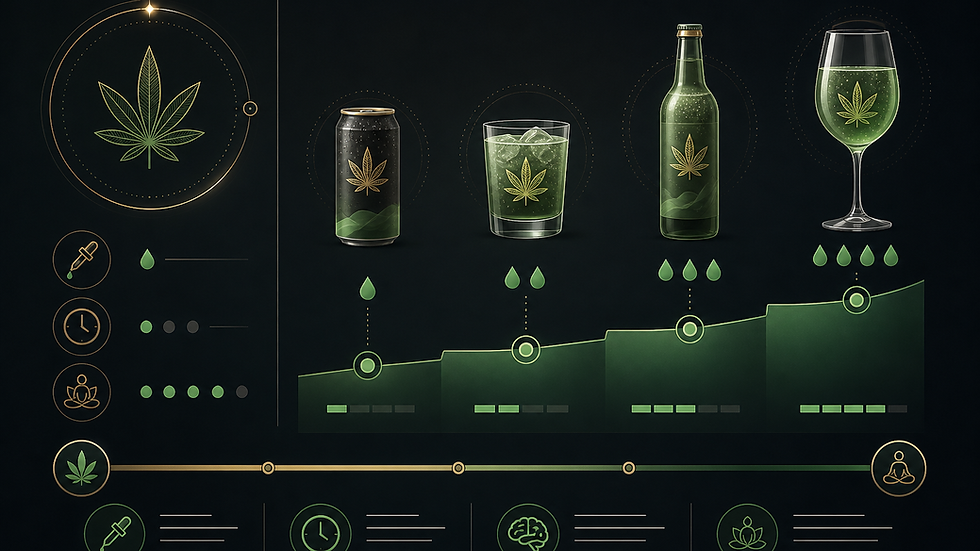
Nano-emulsified cannabis beverages have become one of the fastest-growing product categories in the US edibles market. The technology allows THC to be suspended in water in a form that absorbs quickly, often producing effects in 15–20 minutes. Most cannabis beverage products are formulated at 2mg–5mg per serving, making them a natural fit for low-dose consumers and the growing alcohol-substitute crowd.
How to Read a Cannabis Edible Label for Dose
Whether you are shopping at a dispensary or ordering low dose THC edibles for delivery, these are the numbers that matter:
Per-serving THC: This is the most important number. It tells you how much THC is in one piece, one dropper, or one serving. This is different from the total package THC.
Serving size: Some products list a serving as half a gummy or one of a multi-pack. Make sure you are reading per serving, not per package.
CBD content: Many low-dose products include CBD alongside THC. A 1:1 THC:CBD ratio is commonly used in low-dose formats because CBD may moderate some of THC's psychoactive effects, according to preliminary research.
Onset time: Most edible labels include a recommended wait time before re-dosing. For traditional oil-based edibles, 45–90 minutes is standard. For nano-emulsified beverages, 15–30 minutes. Following the wait time before re-dosing is the most important practical step for avoiding over-consumption.

The industry's general guidance for new edible users is "start low and go slow" — begin with the smallest available dose, wait the full recommended onset period, and assess before adding more. This guidance is widely used by cannabis educators, dispensary staff, and public health organizations across legal markets.
The DC Market Context
Washington DC's cannabis market has undergone significant changes since adult-use cannabis became legal under Initiative 71. The gifting model that defined DC's grey-market era has now largely ended following the DC Mayor's 2026 Emergency Act, which extended medical cannabis licenses and enforced the closure of unregulated gifting shops.
That regulatory shift has pushed consumers toward licensed retailers and delivery services that carry lab-tested, accurately labeled products — including low-dose formats. For a microdosing consumer, accurate labeling is non-negotiable. A gummy labeled 2.5mg must actually contain 2.5mg. That accuracy is only reliably available through licensed, tested channels.
For more on the latest DC cannabis news and regulation updates, visit the Bud Lords Newsroom.
Why This Trend Is Not Going Away
Several forces suggest the low-dose movement is structural, not a passing moment.
Demographics are shifting. The fastest-growing segment of new cannabis consumers in legal markets nationally are adults over 40 — many of whom are motivated by wellness, sleep, and stress relief rather than recreational intoxication. This cohort overwhelmingly prefers lower doses.
Product innovation is catching up. Manufacturers have invested heavily in precision low-dose formats. Five years ago, finding a reliably dosed 2.5mg product required real effort. Today it is a standard shelf category.
Workplace culture is changing. Cannabis is increasingly treated as a personal choice that does not define someone's identity or impair their professional life when used responsibly. Low doses support that framing in a way that high-potency concentrates do not.
Search data confirms rising interest. Google Trends data through mid-2026 shows consistent growth in searches for terms like "low dose edibles," "cannabis microdosing," and "2.5mg gummies" across DC, Maryland, and Virginia. This is consumer-driven demand, not manufactured by the industry.
Shop Low-Dose Edibles at Bud Lords
Bud Lords carries edibles across a range of doses for DC, Maryland, and Virginia delivery customers. Whether you are new to cannabis edibles, returning after a long break, or intentionally building a low-dose routine, the Bud Lords edibles shop has options worth exploring.
You can browse the full product catalog at budlords.com/shop or explore all available products at budlords.com/shop/all-products.
For more consumer education guides on cannabis products, dosing formats, and DC market updates, check the Bud Lords Cannabis Newsroom — updated regularly with guides written for real consumers navigating the DMV market in 2026.
This article was researched and written with AI assistance by the Bud Lords AI Newsroom.
Disclaimer: This content is for general informational purposes only and does not constitute medical or legal advice. Cannabis laws and product availability vary by jurisdiction. Consult a qualified healthcare provider before making any decisions related to cannabis use.


Comments